
Steltix: from ticket integration to manageable service collaboration
Steltix shows how organisations can automate ticket exchange without giving up their own service desk — and how Collaboration Composer adds control, mapping and safe recovery.
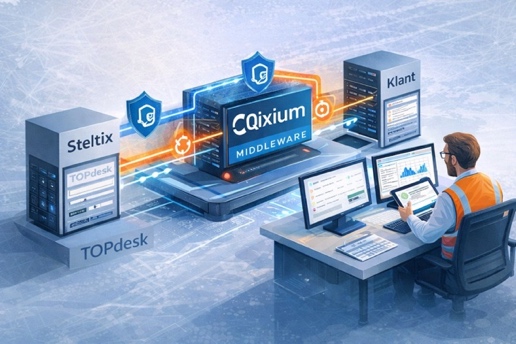
When a customer, MSP and supplier each work in their own service management environment, duplicate administration is almost inevitable. Steltix shows how a manageable ticket integration can make that collaboration much easier.
Every party stays in its own environment
Steltix supports international customer environments in which TOPdesk plays an important role. A ticket that crosses an organisational boundary no longer needs to be registered again manually. Tickets, relevant updates and progress can be exchanged under control while every party keeps working in its familiar environment.
The practical case started with TCH
The initial collaboration was delivered with the TOPdesk Collaboration Handler (TCH). It successfully processed large volumes of service messages without disrupting connected customers and required little to no day-to-day management. Viewer roles also made it possible to give stakeholders visibility without requiring a full operator licence for every user.
“Integration has significantly improved our services through straightforward automation.”
Peter van der Linden · Steltix
From an integration to manageable service collaboration
Collaboration Composer builds on those operational lessons. It retains ticket pairs, synchronises comments, attachments, statuses and closure, and maps differences between platforms. Collaboration is therefore not limited to TOPdesk-to-TOPdesk: combinations with Xurrent, Ultimo, Jira, ServiceNow and Autotask can also be configured as scenarios.
More than knowing that something failed
A search for the ticket number from either side opens the complete collaboration. The timeline shows which information was read, mapped, skipped and written. A missing translation can be added and the action can then be run again safely, without accidentally creating a duplicate ticket or comment.
Solutions, scenarios and technology.
Continue directly from the context of this story.


More from the same context.

NVM gains control of rights, devices and access with SAS
NVM brings HR and IT together in one standardized employee process with demonstrable control over rights, devices and access.
11 Sep 2026 · 95 match
Cosis: control over nearly 4,000 employee changes per year
How HR, IT and support services come together in one controlled employee chain.
2 Sep 2026 · 95 match
Arts en Zorg: getting employees off to the right start
HR data as the starting point for a controlled onboarding process.
27 Aug 2026 · 95 match
Why onboarding automation is not yet IAM control
A runbook can create an account. SAS connects policy, execution, verification, recovery and evidence across the complete employee lifecycle.
6 Oct 2026 · 70 matchRecognize this in your organization?
Discuss your process, scenario or control chain with us. You do not need to know the answer yet.